
Tech: The Rise of the Solution Engineer
Since last November1, our industry has been in turmoil. There’s a lot of noise about autonomous agents, dark factories, and the end of Software Engineering as we know it. And while the noise can be disorienting, we can already isolate some signals in the market.
As with every industrial revolution before it, what we’re witnessing isn’t the end of the profession — it’s the rebirth.
Not One Revolution, But Three
Looking at the market, three distinct modes of AI-augmented2 development have emerged: Conversational — or “Vibe” — coding, AI-assisted coding, and Agentic Development. In reality, no organization or project will sit at a single corner. You’ll land somewhere inside the triangle — and shift depending on what you’re building3.
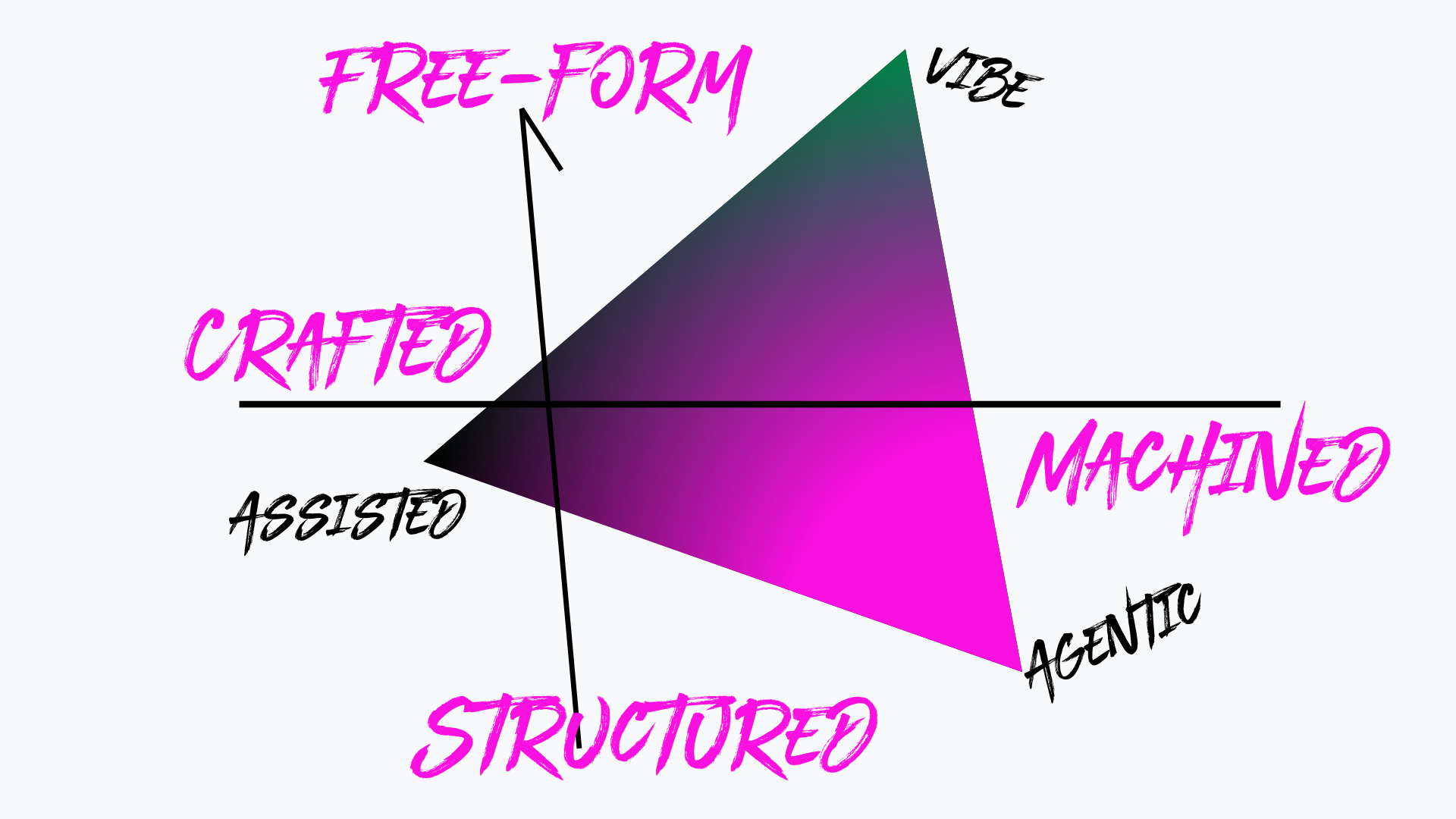
Most of the current excitement centers on agentic development. That’s fair. But even if it doesn’t become the dominant model, the lessons emerging from it will affect the other two. And the most significant of those lessons is this:
The roles of technical people are shifting from craftsman-era roles to industrial-era ones.
Enter the Solution Engineer
All three modes point to the emergence of a new profession4: the Solution Engineer.
A person whose job is to take a business problem — ideally a user journey, a business case, or a product vision5 — and translate it into a technical solution. Using the new, GenAI-powered toolset. The Solution Engineer doesn’t write the system. They define it. They are the editor, not the typist.
The Solution Engineer is still a deeply technical, engineering role. Yes, different from the one we have today — but not something we can fully automate with Lovable and the like.
In practice, the Solution Engineer needs to know everything a good6 software engineer knows today. You still need to understand how authentication works in a browser app, even if Lovable generates the scaffold. You still need to understand data structures, even if an agent designs the schema. You still need to know what O(n²) means, even if you never write the loop yourself. The knowledge doesn’t change. The output does.
What does change is the craft layer on top. You’ll need to learn to manage parallel workstreams, do some context engineering7, write specifications in structured formats — Markdown, YAML, Mermaid, Gherkin — and validate machine output at a level above reading every line of code. It’s a new skillset, even if you get to keep your knowledge.
A Path Forward
The path into this role is there for a deeply knowledgeable product owner, a technical project manager, a front-end developer with five years of experience, or a database engineer. The question isn’t whether they can make the transition. It’s whether they want to — because defining and editing systems is a different identity than writing them.
While I loved the old tribes — UI, front-end, back-end, data, and all the rest — they existed because code was expensive to write, not because there was inherent value in being only a front-end developer and never touching the backend. That constraint is gone.
What comes next shouldn’t be a reduction of the craft. The Solution Engineer isn’t — it’s a restructuring, not a retreat.
Footnotes
-
November 2025 marks the start of the Agentic era in Software Engineering. ↩
-
For the future reader: at the time of writing, the terminology and language here is still very much emerging. Please be gentle. ↩
-
The DORA 2025 report makes a compelling case that failing to take a clear stance on how AI is integrated into development workflows is itself an antipattern. The triangle isn’t optional — you need to know where you are on it. ↩
-
There are likely at least two more, but their shape and form is still too vague to write up with confidence. ↩
-
While we can still debate whether bugs and other incidents also fall into this territory, I believe production fixes and patching can be mostly automated. And thus will be. ↩
-
This is a source of the almost incomprehensible noise around juniors and seniors in the age of AI. When code was expensive, we as an industry often treated juniors as crude labour, and forgot that they had just finished formal training on the topics we only expect a senior to manage. That hierarchy of seniority is now gone, and the industry has to reinvent what a senior means in this age. ↩
-
Not deep end context, agent, or harness engineering — but enough understanding of how to structure context for AI systems to get reliable results. ↩